Shriya Consultancy Services functional testing services to validate the product’s conformity to its functional specifications. A software product should successfully perform its required functions. Functional testing is an integral element in the testing process, which enhances the quality of the developed product.
The success of functional testing lies in finding an unbiased QA testing partner, who focuses both on the application’s usability and the back-end operations.
Our expert QA team starts the testing at the granular level – the individual components and processes that make up the system and then proceed to test the system as a whole. It is highly imperative that the new fixes made out of the functional testing do not impact the application’s key functional areas negatively.
To ensure this, we conduct Regression testing, in which the QA team re-tests the entire application along with the previous fixes.
With proven expertise and experience, we help you in releasing an application that meets the preferred specifications and functionally fit.
Agile software development describes a set of principles for software development under which requirements and solutions evolve through the collaborative effort of self-organizing cross-functional teams. The key characteristics of Agile Delivery model are
> Agile development or Agile Methodology refers to a group of software development methodologies based on iterative development, where requirements and solutions evolve through mutual collaboration and discussion between cross functional teams.
> Agile promotes frequent inspection and adaptation, encourages teamwork, self-organization, accountability, and incorporates best practices that allow delivery of high-quality software.
> It also emphasizes a business approach that aligns development with customer needs and company goals.
> Agile encourages the alignment of project tasks and accommodates change within the project lifecycle.
> Agile methods break tasks into small increments with minimal planning, and don’t directly involve long-term planning.
> Iterations of 1-4 weeks are called ‘time boxes’. Each iteration is considered a full SDLC. Due to small pieces of work done in each iteration, a full product might need several iterations.
> Each iteration aims to produce a working product with minimal bugs.
> The team structure is very different from corporate line and staff organizations.
> The teams are mostly cross functional with development, testing, business and a customer representative being in the team at all times.
> There is emphasis of face to face communication over written documentation. Remote teams can do video-conferencing as well.
> Members take responsibility to deliver the required functionality and internally decide what tasks will be done by whom.
> Most agile teams work in a single open office to facilitate communication
> Teams are generally small (5-9 people). Large software projects may need multiple small teams working together
> Each team has a customer representative present at all times. He is appointed by stakeholders and helps resolves issues
> After each release, the stakeholders and customer representative review the progress with a view to eliminate defects, align output to requirements and get ROI
Agile methodology emphasizes working software as a measure of progress and not delayed software. It emphasizes timely releases instead of waiting to fix all the bugs
Hence, there is less documentation being created. And most requirements are created in ‘user stories’ and ‘discussion boards’
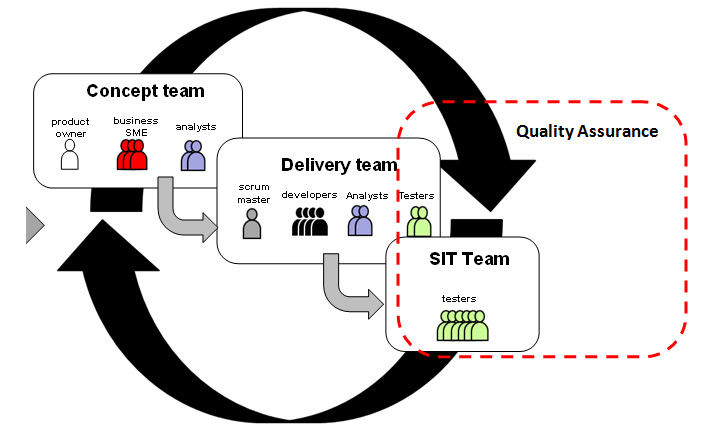
The Agile Delivery teams are broadly classified into 3 major teams namely Concept team, Delivery team and SIT Team. Along with these, there are other teams such as Architecture and PMO team that support all these 3 teams.
The Concept team is responsible to create stories and deliver the stories to the Delivery team. The Concept team works closely with the Business team to prepare the stories.
The stories prepared by Concept team are fed to Delivery team where the stories are consumed and realized. The Delivery team has resources with diversified roles and responsibilities such as Scrum master, Developers, Analysts and Testers. Testers in the delivery team are responsible to validate the User stories that are developed and delivered to them by the Developers. Testers in the delivery team are also responsible to work with Business team to get their acceptance by showing the appropriate evidence.
The validated User stories are then delivered to SIT team. SIT team is responsible to validate that the different components delivered from different delivery teams work together to perform the Business functionality. SIT team is also responsible to validate the Integrated Testing that includes the validation of connection to upstream and downstream systems. The scope of testing for the delivery Testing and SIT Testing are mentioned in the subsequent sections.
Separate teams and bifurcated responsibilities (a producer-consumer model) operating in an incremental-iterative pipeline approach, follow Agile and Scrum principles. Therefore in a nutshell,
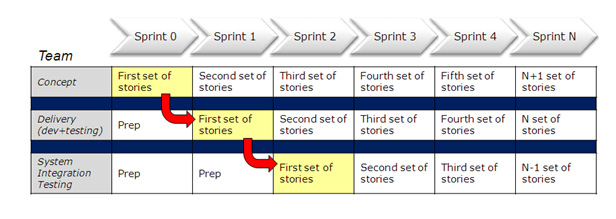
The sequence of stories worked upon by the different teams are shown below –
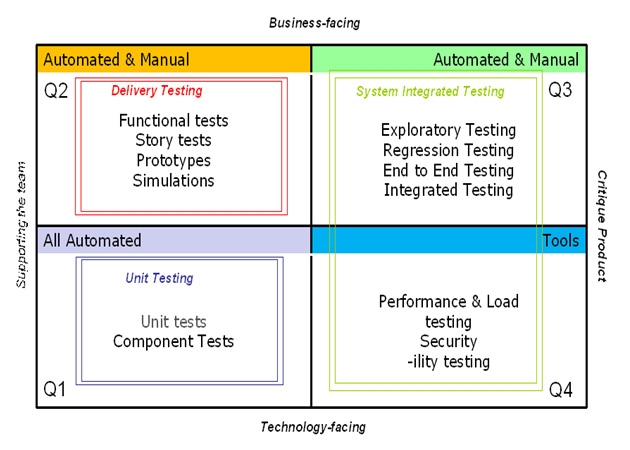
The Agile Testing Quadrants shown below helps Testers and Developers ensure that they have considered all the different types of tests needed to deliver value. The diagram shows how each of the four quadrants reflects the different reasons of testing. On one axis, the matrix is divided into tests that support the team and the test that critique the product. The other axis is divided into Business-facing and Technology-facing tests.